
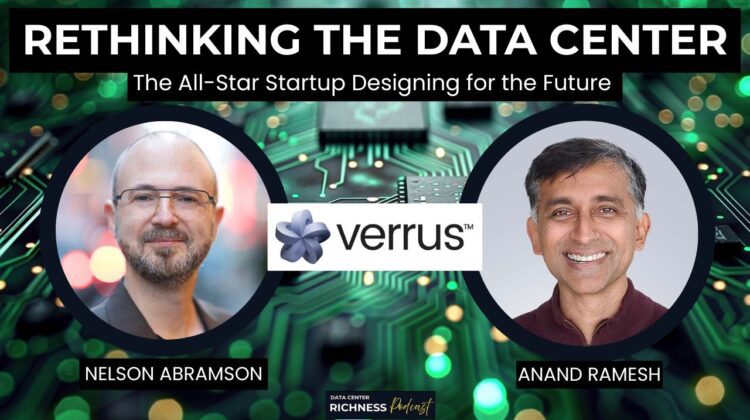
Verrus is a new company seeking to build the data center of the future. It is rethinking key aspects of how data centers are built, and how they interact with the power grid. On this episode of Data Center Richness, host Rich Miller speaks with the leadership team at Verrus, an all-star team of data center pioneers who are designing data centers for 2025 and beyond.
That includes new approaches to some of the huge challenges the industry faces around power and design. Verrus is a company to watch in the next few years. It plans to use software, AI, and deep wells of engineering experience to improve how data centers interact with compute workloads and the power grid. It plans to create grid-interactive data centers that use energy storage and software to work more effectively with utilities, along with data center designs that optimize every watt at every point of the power chain.
Verrus is backed by Alphabet spinoff Sidewalk Infrastructure Partners, and much of the Verrus leadership team helped create Google’s hyperscale data centers. That includes my guests today, Nelson Abramson and Anand Ramesh, the CEO and CTO of Verrus, who will share about their experience at Google. All told, the Verrus team has deployed 13 gigawatts of data center capacity. If you’re wondering what the future of data centers will look like, I think you’’ll enjoy today’s conversation
Rich Miller of Data Center Richness: On today’s show, we’re going to be talking with the leadership team at Varys. I wanted to just start with asking Nelson and Anand to introduce themselves and tell you a little bit about their background and about Varys. Nelson?
Nelson Abramson of Verrus: Sounds great. Well, so excited to be here and thank you, Rich, for the opportunity to come chat with you. Nelson Abramson, I’m CEO at Varys. I’ve been in data centers for just about 25 years. I spent most of that time at Google where I worked on just about every part of the technical stack that makes data centers work. So I’ve done dirt and site selection, I’ve done concrete and steel and construction.
I’ve done server, storage, network systems, system software, application software, planning, logistics, and actual operations of the facilities themselves. I also spent some time running infrastructure at Twitter, and I got recruited to come over and be CEO at Varys and brought out of stealth just about 18 months ago.
Rich Miller of Data Center Richness: Anand, how about yourself?
Anand Ramesh of Verrus: Thanks again, Rich, for having us on. Really appreciate it. Really looking forward to the next hour plus of data center-nery, if you will. So I’m Anand Romesh, I’m CTO of Varys. Like Nelson, I spent a bunch of time at Google, roughly 14 years across two stints. I worked on again, different aspects of Google’s infrastructure stack there, notably servers and storage, as well as data center design and construction, software product management. Also Google Energy where I did a two-year stint, site reliability engineering, which helps manage services at Google, and also did a stint at Edge Connects, which is a third-party data center provider, before coming to Varys to help design and launch the product.
Rich Miller of Data Center Richness: Obviously, you guys have a great deal of experience at Google and at other companies that have a long history in the data center sector and thus are very familiar with how data centers have been built and what innovation has looked like for a long time. With that as background, tell me about how Varys is different, how you thought about creating the company and how you’re approaching the challenges in the data center industry right now. Maybe, maybe Anand, do you want to start?
Anand Ramesh of Verrus: So we are backed by Sidewalk Infrastructure Partners, and when they first approached us about building this together, my first response was, “Well, third-party data center capacity tends to be commoditized. You know, it’s very cool that there is actually appetite for designing and building a better data center. I’m not really sure that anyone is in the market for that.” But honestly, our hope is, is the capacity angle, right? Because what customers care about is capacity at the right time in the right place, and that is what Varys is uniquely positioned to deliver through very interesting and novel technology, but we are offering capacity in markets that we’re pretty sure customers want to be in. That is our value proposition, first and foremost. Secondly, it was the opportunity to work with folks that I had worked with for a while. So I’ve known Nelson pretty much from the day I started at Google, and I worked with him on and off over, you know, the past two decades, and this was too good an opportunity to pass up to kind of do this, do this again, get the band together, so to speak, again. So, yeah, like those were our motivations, at least from my point of view, of sort of jumping in with both feet. Yeah, and we’re incredibly excited about the future.
Nelson Abramson of Verrus: Yeah, and I, in my mind, first and foremost, we’re trying to build the kind of data center company offering the kind of products that we wished had existed when we were on the other side of the table. And I think when we came into this, I had sort of a similar emotional journey to Anand, which is like, “What’s the approach here that’s something other than just building another data center?” And, you know, from my mind, when I look around, what I see are data centers that are much bigger than they used to be. The first data center I worked in was at the time a mind-boggling 1.3 megawatts of power, which today is like what, you know, a rack and a half or two racks.
So it’s incredible the journey that data centers have been on technologically and in every dimension. But what I see is fundamentally the same data center but bigger. And I think if you took a data center today and time-traveled it back into the into the ’90s, like it would look very familiar. And I think what’s happened is we’ve experienced such rapid and incredible growth of demand and scale for what it is to be a data center that everybody’s just been racing to keep up. And to our mind, it’s like, “Well, once you start reaching these kinds of scale points, there’s an opportunity to fundamentally re-evaluate what a data center is.” And rather than looking at it as a piece of industrial real estate that happens to consume power as a side effect of it existing, it’s really fundamentally an energy asset that happens to need real estate because you got to put it somewhere. And that where that somewhere really matters.
Nelson Abramson of Verrus: I’m not suggesting the real estate part of it is not important, but you really have to think about it as an energy asset first. And once you make that mental leap, it opens up a whole bunch of other doors. You’re like, “Well, what else can we do if we think about data centers as an integrated technology system, as an energy asset?” And it opens a whole bunch of potential doors that let’s us do something different while still delivering fundamentally the same product to customers, which is space, power, cooling, you know, capacity for your servers, whether it’s GPUs or compute and storage. But it’s delivering that product in a way that really meets the current moment. We think about grid constraints, we think about scale and scale constraints and like, “Okay, hey, we want like three times the number of data centers ever built in the next five or 10 years.” Like that is just, that that’s an incredible amount of data center we have to build. We got to do it different.
Rich Miller of Data Center Richness: So in doing it differently, you mentioned meeting the moment. Power seems to be the story of the moment. You mentioned the constraints, lots of markets. It’s hard to find power in the scale and timelines that folks would like. In thinking about Varys and what you might, how you might approach that differently, tell us about what you guys are looking at, where, where are the solutions here?
Anand Ramesh of Verrus: This is actually very timely, Rich, because we know you, you posted Tyler Norris on your podcast a couple of weeks ago, who spoke about what demand flexibility can actually do towards alleviating some of the power shortages that are widespread in the industry today. We happen to concur very, very sort of studiously, I should say, that yes, this indeed is the opportunity to sort of unlocking significant amounts of capacity on the utility grids out there. So Nelson basically mentioned that, hey, we’re looking at data centers being an energy asset. The sort of extension or the national extension to that is that we don’t envision data centers of the future being passive consumers of electricity as they have been in the past several decades. So usually the way things work is that a third-party data center provider or hyperscaler arrives in a, in a utility area and, you know, they ask for an interconnection. A substation gets built and then they drop out.
The way that things are going to work, we believe, is going to be quite fundamentally different, which is that the utility interconnection is going to, going to be accompanied by some level of flexibility that’s being asked of this very significant consumer of of load, specifically, during peak hours. And those peak hours could vary between dozens of hours to hundreds of of hours a year where data centers may be asked to essentially appear to the utility as if they’re dropping. So the trick in doing this is going to be in a manner where customer workload is actually not impacted. So it’s one thing to go ask customers to go and shed workload. It’s another thing to go to customers and say like, “Hey, you know, we’re able to actually deliver this without any net impact to your workload.” And if there is additional flexibility that that customer workload can bring to the table that’s over and above what we can actually do, the way that we want to do this is fundamentally with energy storage.
So we want to deploy long, long-duration energy storage in our data center campuses that will go a long way towards creating dispatchable resources, firm dispatchable resources for the utilities, that basically unlocks the flexibility that’s needed to deliver this interconnection capacity. That is our kind of fundamental approach where we want to start with long-duration energy storage as the key mechanism by which flexibility is offered and then slowly walk our way with customer participation, if they so desire, to adding IT workflow flexibility into that mix.
Rich Miller of Data Center Richness: So Nelson, to build on that, energy storage systems are something that, you know, haven’t necessarily been as prominently featured in in data center usage and and cooperation with the grid to date. So much apart from a traditional UPS system, normally the setup is you would go to a UPS and until you can start up some generators and that’s how you would run if the grid is out. What has enabled you guys to think a little bit differently and and approach this, the the data center as an asset?
Nelson Abramson of Verrus: Yeah, I think a number of different changes have happened across a bunch of different industries, all that kind of have related and interconnected into data centers, and they’ve all kind of converged into the current moment. And so a big piece of it is just when you’re talking about citing a 5 or 10-megawatt data center load, it’s just a different level of consideration for the utility, for the transmission and delivery systems that they have, and for their generation portfolio. When you’re talking about a gigawatt data center, that’s no longer something that can just kind of tag along with an industrial park or even a commercial park. I mean, again, the early data centers I worked in were, you know, behind a packing warehouse or a post office, right? And that, that just, that those days are gone.
And so when you’re talking about citing a gigawatt data center or multi-gigawatt data center, at that point, you’re having the same kinds of conversations with utility that you have to have when you want to cite a power plant because it’s the same kind of impact to the to the, the grid. And so the first is just data has gotten so big and so concentrated that we have to think, we’ve had to think about them separately. I think we also should be thankful to electric cars for driving the price of lithium batteries down, and not not just lithium batteries, battery technology in general, converter technology. Like the result of all this incredible global investment and production and design of electric vehicles, now you’re like, “Oh, well, actually, we have, we can take advantage of that technology from that from a cost perspective, but also from a complexity and sort of proof of work perspective.” And we have these systems that didn’t exist before.
And I think the the other is the evolving perspective of, you know, how reliable the grid actually is and a fundamental willingness to to look at the needs for reliability and durability to outages in a holistic fashion, which is like, hey, there’s a whole bunch of categories of failures. How, what is the best way of actually approaching these as opposed to just, this is the way we’ve always done it, or, you know, this is this is the way we did it in the last data center, so it has to be the way we do it in the next data center. Instead, it’s like, let’s look at this clear-eyed and through a, what do we want to get out of it, kind of perspective, taking into account all these other things that are happening, which are like fundamentally, you know, a little bit orthogonal to data centers themselves.
Rich Miller of Data Center Richness: So do you have any examples of of of what some of the the new or different kind of things you could, you know, think about in in managing that? And in terms of like, how are data centers take advantage of all the scale and the opportunities here and the the changes in the market?
Nelson Abramson of Verrus: I think there’s a few that are probably the most interesting to to you and to your audience. I think one is that our our data centers take a novel approach to the design and implementation of the electrical infrastructure to be incredibly more efficient in terms of how many racks you can get on the same number of kilowatts. And so you can get approximately 30% more racks into the same underlying megawatts with a Varys data center that you can get from anyone else. Another is our approach to how that facility is delivered allows you to to use a wide variety of deployment vehicles. One of the things that I faced in my previous role was always a challenge for knowing what what kind of racks and servers and form factors you were going to deploy. The only thing I could ever guarantee was whatever we assumed was wrong and we would regret whatever we had assumed in approximately six months and sometimes six weeks.
And, you know, and that was even before the incredible advancement and replacement curve that we’re seeing on GPUs. And so, you know, core element of what we’re building is flexibility to, hey, do you want a lot of water cooling? Do you want a lot of air cooling? Did you change your mind and then you want to go back to water cooling? Do you have dense racks or not so dense racks? You know, the the the ability to have that flexibility is is a key element to the kind of data center that we’re delivering. And then the final piece is our special relationship with the utilities because we’re able to bring not just the promise of flexibility or or, you know, small number, small amount of nominal flexibility. We can actually offer firm flexibility through our use of on-site behind-the-meter resources that don’t have the kinds of run restrictions that you’d have on a diesel. Utilities are willing to work with us in a in a unique way and help and let us help them to unlock capacity, similar to what Tyler was talking about in his paper for like, “Hey, you know, there really two grids. There’s the grid that happens whatever 8,500 hours a year, which is there’s plenty of room, plenty of room in the generation portfolio. There’s plenty of room on the T&D side.”
And then there’s the grid that happens a few hundred hours a year when it’s a super hot day. Everybody comes home and cranks their air conditioner, and the the sky is a little cloudy, so solar’s not doing great, and it happens to not be windy, so wind’s not doing great. When you have those days, those hours, those days, it’s a very different grid. And so thinking about these things as different planning problems and different operations technology problems again, sort of opens your mind, opens your opportunity space in a way that that isn’t when you when you have to think about just this one operating point that has really very little flexibility in it.
Rich Miller of Data Center Richness: Right. And to just to quickly summarize for those who haven’t seen our podcast with Tyler Norris, the idea is, you know, Tyler and his his colleagues at Dukes did research effectively showing that if data centers could be flexible for a certain amount of hours a year, it changed the way that the utilities can think about of their peak demand that and that if there could be more flexibility and cooperation there, then the data center load request could be thought of slightly differently. Anand, is that about right?
Anand Ramesh of Verrus: Yeah, that’s that’s basically exactly right, right? So the, I believe the rough order of magnitude that was quoted was hundreds of gigawatts or 100 gigawatts or thereabouts. That’s the, that’s the entire idea behind the premise. To also add on to what Nelson said, I think the value propositions around around, you know, load flexibility as well as design flexibility et cetera sort of near and dear to our hearts. But I think I want to sort of also underscore that customers need not modify their workloads or their deployment patterns in any way. Data centers should look and feel like a traditional facility that they deploy into without them needing to really modify anything about their deployment patterns or their deployment methodologies.
Rich Miller of Data Center Richness: Yeah, well that was going to be one of my my questions is, it sounds like, you know, what you’re, most of what you’re talking about is things that will happen on the back end. One of the things I’m interested in is the utility relationships because that’s one of the things that over the years a lot of data center companies have not been eager to think of themselves as power companies or or being in the energy business. What does that relationship look like or what should it look like now and how are you guys thinking about that?
Nelson Abramson of Verrus: Yeah, I mean, that’s a key part of how we’ve built Varys and how we have changed our approach from business as usual, which is engaging utilities really as strategic partners. And that requires us to operate a little bit differently and and, you know, think and act a little bit differently in terms of how we engage with the utilities. But I think what we’ve found is the utilities overall are hungry for a different kind of approach. I think nobody knows better than the largest utilities how challenging it is to just continually connect these data centers that operate as black boxes and have and offer and offer the grid really no, no upside other than load. And, um, you know, as you were mentioning, Rich, in the, what the Tyler’s paper showed, even just small amounts of marginal flexibility really unlock things in in a similar way. I think the the planning metric is something like each nine you add is like double cost. It, it’s something similar where like, for a utility, the farther out you go in the curve, the harder it is for them to meet the demand and like the most extreme, extreme, extreme opportunities.
And so being able to offer those kinds of opportunities to those kind of options and affirm options to a utility that allow them to to to play their planning game in a more effective way, uh, you know, we, we found in general utilities are are very interested in this approach and and are are really looking for something different. And and the thing that that we’re bringing, I think this is, you know, this is a new space. I think there’s been at this scale for these kinds of, uh, uh, these kinds of flexibility needs. It is a fundamentally new space. And so we’re, we’re excited to be working with some of the more, most thoughtful and forward-thinking utilities in in the United States on what should this look like? How should we structure it?
What, what, you know, how is this actually going to work in a way that delivers enough value for the utility to unlock this stranded capacity and at the same time offer the right kind of grid interconnect that a data center can still operate well because in the end, a data center is in the business of providing capacity for compute, storage, GPUs. And so, um, you know, this has always been one of the key blockers is like, how do we, how do we strike this balance between these needs, teams in a way that everybody gets enough of what they need that it works well?
Rich Miller of Data Center Richness: So, and let me like then ask, what are the components that you can work with in crafting a different relationship with the utilities? Is it individual contracts with data centers? Is it, you know, tariffs? What are the moving pieces here where you guys can approach things a little bit differently?
Anand Ramesh of Verrus: It’s been a process of discovery for us, right? So, utilities are incredibly complicated organizations and they do incredibly complicated things. It’s not an overstatement to say that the electrical grid is probably the the most stunning human achievement of the last 100 years. It’s basically underscored like, you know, every single boost in productivity that we can think of, uh, from lighting to air conditioning to computers. So, we understand and appreciate that these are incredibly sort of complicated systems which require very careful kind of care and feed. So, to answer your question specifically, there is no one-size-fits-all approach, right? So, in the sense that every utility has very specific needs and it isn’t even a utility by utility specific conversation. Oftentimes, it’s a it’s a region by region conversation within that particular sort of utility area. And the kinds of offerings that we come up with are oftentimes in direct conversations with them after they do modeling and studying on their end. So it’s very much a two-way conversation which takes time to kind of build and evolve.
Anand Ramesh of Verrus:: The hope is that we can actually begin standardizing some of these offerings which do have sort of a certain level of commonality, say, across 80% of deployment scenarios, and we have no intention of kind of keeping that sort of thing proprietary, right? Like, I think we believe pretty strongly that it’s going to benefit the whole industry if there’s a certain set of offerings that can be essentially be made public where data center companies may be asked to to kind of participate in that set of offerings. So, yeah, like, it’s not a satisfying answer necessarily to your question, but it is a very utility-by-utility and region-by-region conversation, and that’s kind of why it’s painstaking, but I think it’s worth laying the road because once the the the road is built and driving on it then becomes a choice, right, for different data center companies.
Rich Miller of Data Center Richness: Yeah, it seems like there’s a couple of other folks thinking about this. There’s the EPRI has the DC Flex program, and it seems like there’s a lot of thinking going on in this area. Nelson, I wanted to come back to to design. One of the things that you mentioned that you’re thinking about power design a little bit differently, there’s been a lot of discussion of because of the density and and that maybe folks have to think about distribution differently. Is that part of what you’re looking at or from from the design perspective, what are the things that have to change to meet the kind of workloads that we’re we’re seeing and and customers are trying to manage for?
Nelson Abramson of Verrus: I mean, I think the short answer is definitely yes, in terms of are we looking at it and does it need to change? I actually think Anand is much better at describing it than I am, and so I I I would point to to Anand to to answer your question.
Anand Ramesh of Verrus: Well, I I hope your eyes don’t start gazing over as I sort of launch into, you know, raptures about electrical design and mechanical plant design. But I’ll start with like a very simple set of observations, right? So, very traditionally, there’s an interconnect request that gets made for, let’s say, X00 megawatt, uh, let’s say for the sake of argument, it’s for 200 megawatt. Approximately, 125 megawatt gets allocated to it, 75 megawatt gets allocated to to cooling and other overhead, right? Like, you can work out the PUE math. And then out of that 125 megawatt that’s allocated to it, it ends up getting built over a course of three or four or five years, and when the campus is fully operational, the power meter will tend to read somewhere between like 75 and 90 megawatt most of the time. Sorry, we are so serious about efficiency that the lighting timers are set to a very annoying 10 minutes. So, the upshot is that an interconnection request is made for 200 megawatt and the actual use that’s seen by that substation is of the order of 150 megawatt. You almost never end up using the full power capacity that the substation has been designed for. So, in today’s context, given that that capacity is reserved, we think that’s a pretty significant opportunity, which is independent of all the flexibility value propositions that Varys wants to bring to the table. So, we are coming up with what we think is a new metric called overall utilization of energy. We think that the ratio of power that’s basically supplied to the campus to what’s being used by it is something that customers should pay a lot of attention to, right? So, that’s from the utility context, and then a customer who leases from us, let’s say they lease 125 megawatt from us, should get to use the entire 125 megawatt as opposed to having the utilization sit at 75 or 80 megawatt. So, that metric we think is going to be really interesting and relevant moving forward as we take advantage of all the power that’s delivered to our campuses.
Anand Ramesh of Verrus: So we do this in two ways. The first way is through through electrical distribution. So the cheapest data center is the one that you never have to build, right? So if you can deploy additional capacity in our buildings without any negative electrical effects by simply taking advantage of utilizations of data centers that are that tend to be significantly lower than 100%, we think that’s a win for the industry. The second is by obviously by optimizing mechanical plant design so that we’re allocating as little of the power as possible to to cooling and other overheads, which again is like a very traditional kind of a PUE optimization play, right? So the way that we do this is again by electrical design where we’re trying to pull electrical capacity at higher and higher levels, so more of that capacity is available for IT anywhere on the data center floor. So that in a nutshell is kind of how we go about our design and how we believe our data centers are going to be a better value proposition for not only for the utilities but also for the customers because they need to buy lesser Varys capacity to essentially get the same amount of workload that’s deployed.
Rich Miller of Data Center Richness: Yeah. And in terms of the opportunity there is that it seems to me that there’s there’s hardware design, instrumentation, and and software. Are those all pieces of the of the puzzle, or is there any one aspect of the pie that you guys think you can focus on and improving results there?
Anand Ramesh of Verrus: So it’s really all of the above, in all honesty. So the one thing that I want to be careful and again stressing is that this is a complicated integration problem. So we have different layers of of infrastructure that we’re deploying in a Varys data center, and control systems, for example, is something that we take very, very seriously, given the amount of energy storage that we’re deploying as well as optional backup, very traditional optional backup generator capacity. You need to find ways of managing these assets on your distribution system in a way that does not actually compromise stability and does not compromise availability of the data center as a whole. These are very solvable problems, but we are taking learnings in different fields and applying them to the data center field. So yes, there is a certain level of discovery, but it’s not like we are coming up with new control theory, right? So that’s how I like I would describe it. Similarly, on the on the flexibility angle where we want to future-proof customers, we want to ensure that mechanical plant designs can tolerate a variety of interface conditions. So for example, air-cooled workloads want a certain type of an interface condition to the data center, and liquid-cooled workloads may want a slightly different interface condition, and we want to design in the hooks for allowing customers the most amount of flexibility in terms of deploying one workload versus another.
Rich Miller of Data Center Richness: Nelson, I’ll come back to you with the business element of the opportunity, which is one of the reasons there’s been a lot of interest in the the Tyler Norris paper and in flexibility is the idea that maybe this enables capacity and time to power in ways that that hasn’t been possible before. Well, what what do you see as the possibilities as you talk to to the utility industry?
Nelson Abramson of Verrus: I’ll touch on both the sort of customer-facing value as well the utility value. I mean, on on the the customer value, my CEO version of what Anand said is you buy three data centers from Varys and you get the fourth for free. I think it’s hard to overstate the potential impact of that kind of improvement in TCO for delivering the data center, particularly in a world where, um, you know, we have pretty much every cloud service provider CEO getting up and saying on stage, we’re on an earnings call, like, our primary problem is build the data centers fast enough. So like, pulling a data center, like, making it so you have to build that data center, is both I think a huge win from a from a sustainability, from a climate, from an impact perspective, but also just straight from a business perspective of like, that’s just a building you didn’t have to spend on. On the utility side, we are definitely seeing an opportunity both from a a time and access perspective for like, utilities just can give you a different answer when what you’re asking for is much more of a configurable, manageable planning object rather than this black box all or nothing answer that provides no grid services. The moment we bring in the grid interactivity, the grid services element of it, it can and does fundamentally change the kinds of answers that we get from utilities both from a cost, complexity, and timing perspective. But also in terms of the, you know, the broader impact for all this load growth and all this data center growth in particular to ratepayers. One of the best ways to stabilize rates for utilities for utility ratepayers is to allow the utility to deliver more power on the same grid. And so the more we can drive up the utilization of the grid on the like, you know, as I was saying before, it’s like kind of two grids, there’s the grid for 8,500 hours a year and the grid for 260 hours a year. The more we can drive up the utility for 8,500 hours a year without driving up the utility, the grid for the 260 hours, what that ends up meaning is the utility is able to spread their fixed costs over a larger and larger pool of power, which then stabilizes the the rates for everybody else. And so it really addresses, I think, one of the key fears about data centers is like, the the potential cost shifting, like, no, actually, we can go the other way where it can shift costs in the data center space simply by structuring that interface in a different way.
Rich Miller of Data Center Richness: Let me back out just a little bit, take a slightly wider view in terms of business models. Where you guys kind of fit there? There’s a lot of different ways in which folks now a day are approaching data centers in terms of, you know, powered land, the developer, some people just will will lease all their space. Talk to me about the way that Varys is approaching the market, what you’re building, and what that looks like.
Nelson Abramson of Verrus: We are a full-stack developer. And so we have we have sites with power and we’ll be building data centers on those sites for to at least to customers. You I think what we see as an opportunity to to pull all these things together and deliver a a competitive product out of the gate. You know, just to to reinforce something that Anand had said earlier, although there is a whole bunch of opportunities for customers to take advantage of our unique design and value propositions, the entry point does not require any customer-side changes. And that includes our ability to be market competitive.
And so customer can start with a Varys data center just the same way they’ve always used data centers, roll their racks in and get data center capacity. It allows them to to dip their toe into the water and see the direction that the industry is going to go without having to take any of the change or the risk on on themselves.
Rich Miller of Data Center Richness: In terms of thinking about how you guys come out of the gate, obviously, developing at campuses at that scale is a capital intensive business. How are you thinking about how much to build when?
Nelson Abramson of Verrus: : I think there’s a couple of elements there. We’re looking to build data centers in the markets that matter. And so I think the the long-term direction of this is going where data centers want to be rather than just happening to find a substation somewhere that has capacity. And so we are, you know, we’re looking in the major markets where all the customers want to be.
The second is standing up a team, as as you’re implying, building data centers is not a business you want to cut your teeth on the first time at scale. This requires a a team of of experts, which we’ve assembled from the best hyperscalers and from the the top three PDCs, because to do this, the only way to know how to do this, the only way to build at scale is to have already built at scale. It’s just fundamentally different to build a gigawatt campus than it is to to retrofit a heckinger, which is one of the first data centers I worked in, which, you know, hey, it met that moment, but I wouldn’t want to do that now. And so building the right team is critical.
And the last element is, you know, we’re we’re part of the Sidewalk Infrastructure Partners family. Their LPs are the some of the largest infrastructure investors in the world. They’re excited to be on this journey with us, and that’s a that’s a key piece of this because that, you know, to to build this is incredibly challenging in every dimension. One of those is got to be able to deploy the capital to to actually make the project work.
Rich Miller of Data Center Richness: Anand, let me ask you about just the moment that we’re in. We’ve talked about there’s a lot of big challenges. I you guys are looking at this as a big opportunity. It seems like an an exciting way to approach the market. What what’s your take about what’s possible here?
Anand Ramesh of Verrus: Without sort of injecting too much hyperbole into the conversation, I do fundamentally believe that data centers are going to change in a very fundamental way, right? So the way that data centers interact with utility grids and communities and with their own customers is going to look very different two, three, four, five years from now. It is not going to be business as usual. But that being said, we also understand our customers are placing a tremendous amount of faith by deploying workloads into our facilities. So how do you sort of ensure that what you deliver can support their mission-critical and revenue-critical workloads that they choose to deploy with us? And the only way to do that is through rigorous engineering, significant amounts of simulation and testing, which we can try and be as transparent to the customers with.
So specifically, what do I mean by that? Like I said, there is technical complexity in what we’re trying to do, but one of the ways that we want to kind of bring the the customer base, the the utility stakeholders, and the industry along is by working with credible third parties such as the National Renewable Energy Labs, for example, where we can kind of demonstrate at scale how our system actually reacts in in a dynamic fashion, right? Like what are the transient effects that we’re seeing, how we mitigating them, and so on and so forth.
So that’s something that we want to be like very intentional about. We also have a pre-production environment at our facilities. You don’t generally hear of a lot of third-party developers building test facilities for for themselves, but again, one of the key sort of things that we want to do at our pre-production environment is by reducing integration risk. So what we don’t want to do is to go to facility commissioning and then flip the switch on and sort of cross our fingers and hope that things work, right? So we want to kind of do a lot of that troubleshooting and debugging before the fact where we have production-intent infrastructure that’s deployed, which is talking to our control systems and our software monitoring systems.
That’s the opportunity in front of us. We take it very seriously. We do acknowledge that, you know, designs et cetera are going to evolve, and the way that we are trying to make that as painless as possible is number one, by ensuring that customers don’t have to change their workloads or their deployment patterns. And number two, by being as transparent and intentionally as we can with this development process that we’re on and sharing the results with the with the community at large.
Nelson Abramson of Verrus: And just to add on to what Anand said, as an example, like we just we just co-published a technical report with NREL demonstrating what we did and and how it worked and and that the Varys design delivers the utility-facing value, the grid interactivity that we’re promising at scale.
Rich Miller of Data Center Richness: And obviously, we can share I’ll link to some information on your website about the work with NREL. Nelson, you talked a little bit about the designs that might come into the data center as we see very dense and advanced workloads. I think that we’re seeing with AI hardware is the modeling getting better to be able to to work with customers as they’re coming in there. There’s a lot of discussion of AI factories and digital twins as as an opportunity to make it much easier to build a data center ahead of time and and to reduce the amount of surprises when you actually try to commission something. What’s the opportunity there?
Nelson Abramson of Verrus: As much as we’re building data centers to house GPUs and AI for other people, it’s also like a fascinating application of AI and AI-related kinds of thinking to do improve modeling on the data centers themselves. I think as with many applications of AI, we’re we’re figuring it out as we go. It’s all it’s all new spaces. But it’s it is a piece of what we’re looking at, which is, hey, what, you know, the one of the things that makes data centers so, I mean, so frankly, so cool and exciting and interesting for me is just this interface between digital and analog technologies where some of it is digital, you can model it, it it follows sort of code logic. And some of it is, well, these are like physical things that sometimes move and they do weird things that the manual says they shouldn’t do.
And really, the only way to find that out is to like test it, and not just test it once, but test it a whole bunch of times. And sometimes the implications are actually quite subtle. And so I think there’s a big opportunity here for being able to use an LLM-like approach, how can we build a better digital twin for this data center and, you know, test it 10,000 times in all these different ways and and really identify some of these sort of subtler combined moments that might otherwise not jump out to a human observer but could very well jump out to a sort of digital twin analysis mode.
Rich Miller of Data Center Richness: Nelson, what are the the things about Varys and the way you guys are thinking about the data center development that are important for our audience to know as they think about how this this industry changes going forward?
Nelson Abramson of Verrus: What we’re building is the the where the place where data centers will be in the next five to 10 years. And that that when I think about that, I think of combining a whole bunch of elements that we’ve sort of touched on as we went through this conversation. But, you know, maybe it’s useful to to sort of tie them together. Like a key piece is the right team that has the experience to really be able to look at this and it’s not just the data center technology, but it requires looking at the data, the core data center technology. It requires looking at sort of software and control systems and operations. It requires understanding construction and supply chain. It requires energy, like all all these different pieces have to have the right team built around them, assembling that team, having the right people, having the right approach, and knowing how to how to make the right kinds of trade-offs because everything is about trade-offs. That’s the first and most important piece.
Like the second being approaching utilities fundamentally differently, right? Like offering not a an abstract promise, but like, this is how we can do things differently. This is the kinds of things that we can do, and this is this is how we can work together to understand how it’s going to change the grid for the utilities and meet the moment for them so that we can work together and unlock capacity is otherwise just going to sit stranded. And then there is the advanced design and implementation that we’re talking about, whether it’s on the energy side, on the on the the power distribution side, on cooling, on how we deliver that capacity onto the floor, and how we work with the the customers who are interested in seeing the market move forward and looking to do the next new thing. And I think all feel like they are not where they want them to be, where should it go? And so pulling all these things together lets us build that data center of the future and chart that course that, you know, we’re excited to do, and we’re excited to get there with the rest of the industry too.
Rich Miller of Data Center Richness: Any final thoughts?
Anand Ramesh of Verrus: I think that was a very, very elegant summary by Nelson, and, you know, this industry is sort of at a turning point right now in terms of how it’s viewed by utilities, how it’s viewed by by communities, and how it’s viewed by the customers themselves. And I think there’s really, at the risk of a little bit of hyperbole, a generational opportunity to to fundamentally change how we think about some of these these interactions and these problems, not only in a purely technical sense, but also in a in a commercial sense, like we’ve discussed over the last hour. So, very exciting times for the industry for sure.
Rich Miller of Data Center Richness: For both of you, thank you so much for for taking time. This has been a fascinating discussion about where we’re at and where the industry might be going. If people are interested in learning more about Varys and what you guys are doing, Nelson, where can where can they go for more?
Nelson Abramson of Verrus: Well, thank you for the opportunity, Rich. It’s been a great conversation. I’ve been, you know, long, long time, long time reader, so it’s great to be able to chat live with you. I think the easiest and most direct place is either finding us on LinkedIn or varydata.com, which is our our website, and all of our core publications are there.
Rich Miller of Data Center Richness: Thanks to Nelson and Anand for sharing their vision for Varys, and I want to thank you for listening. If you enjoyed today’s show, please take a moment to give it a like or a review and be sure to subscribe to our channel for more Data Center Richness.
