
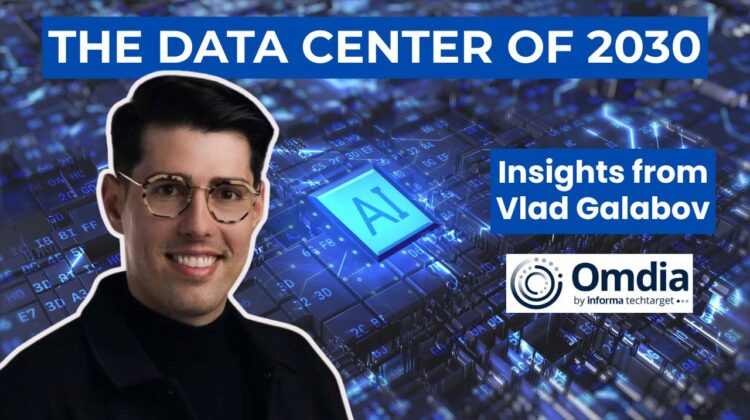
What will the data center of 2030 look like? How will design and technology change as AI moves to the next level? Those are the questions that Vlad Galabov and his research team addressed at the Omdia Analyst Summit at the recent Data Center World conference.
Vlad is the Senior Research Director for Enterprise Infrastructure at Omdia, one of the market intelligence services at Informa TechTarget. At DCW we got a chance to talk with Vlad about how AI is changing the way data centers are designed and built, and how Omdia believes the market will evolve.
It was an interesting conversation about AI and the road ahead. That includes a look at the growth on-site natural gas generation to support AI data centers, and how adoption of liquid cooling will scale dramatically to support high-density racks from NVIDIA.
Rich Miller of Data Center Richness: Vlad, why don’t you introduce yourself, tell folks what you do.
Vlad Galabov of Omdia: Sure. My name is Vlad Galabov. I am the senior director for enterprise infrastructure at Omdia. And my research team is an engineering-based research team, so a technical research team that looks at different technologies that are deployed in the data center and, of course, answering the question of how big is the market, how big are different opportunities, what are the big challenges, what are the big risks, and where the opportunities lie.
Rich Miller of Data Center Richness: So you guys like to look ahead and make some projections about where things are headed. You did a report for 2025, and now you’ve just done a data center 2030 report. How would you sort of compare the environments in trying to prepare these reports and how things have changed?
Vlad Galabov of Omdia: Yeah. So when we did the 2025 report, we looked at the demand for different types of compute. At the time, we kind of almost showed that there’s two development paths for computing: one is for high-performance computing for AI, and one was for efficient general-purpose computing. When we made that report for 2025, it was before the ChatGPT craze. There were certain things that for us, from a semiconductor perspective, that were clear. It was very clear that semiconductors will become more powerful, that they will require a new type of infrastructure, and how these components are integrated will change. So luckily enough, despite the fact that we made this before ChatGPT, we did understand the pace of change and the design element of how computing is structured in a small, high-performing pod, and that this means that you will have to cool it, power it in different ways. So I think that was pretty clear.
And then, on the efficient computing side, our prediction was really about what are the economics of general-purpose computing. A lot of what we kind of focused on is there’s so many servers out there, there’s so many computers, you have to start to have a more efficient way of running that. So we touched upon how we might see consolidation in general-purpose computing, and we have seen that. So doing the 2025 prediction a few years ago, it was very much kind of chasing the most logical stream and then also aligning our forecast with what we believe is the technology development.
When we look at 2030, there were a few things that became very clear for us. The pace of change is shortening. The pace of innovation, the cycles of innovation, are very short now. And one of the reasons why they’re short is that we have very ambitious computing companies. I would put Nvidia in the category of a super ambitious computing company. They want to have a very quick cadence of change, and the reason why is that they’re a computing company that is also a software company, so they can see what software requires. As a result, a lot of their computing ideas are actually grounded in software. However, how we change data centers is not in these super rapid cadences. So at the moment, there is a little bit of a disconnect between what AI scientists would like to do. I think AI scientists would like to improve how AI works very fast. But to do that, you need significantly more computing than what we can give them today. But to give them more computing, you need a change in the power delivery mechanisms and in the cooling mechanisms of the data center. So that makes it really challenging within our 2030 predictions.
One of the things we talked about was that there is a new wave of co-development that’s required in the industry if you want to make the super capable computing. There’s been talk of one-megawatt racks, and to do this now, the level of collaboration and co-development that is required is very, very high. So that kind of became very clear: if you want to develop fast, you need to develop together. So that was one of the things we looked at. We looked at the topic of power, of course, because you can’t escape it. And we believe that the self-generation movement is going to go very fast. Full transparency, we do have a very early view into the signals and the order books of the power generation vendors for self-generation. So that helped us, and I believe that will be pretty accurate there, but we did have some very clear insights into the pipeline there.
A few of the predictions for 2030 are grounded in the adoption of AI. We think that we’re only scratching the surface of adoption, and the reason why is that the productivity gain that we can have is tremendous. I think what we could potentially achieve and how many trivial tasks we do today in the world of technology could be potentially improved. How we even make a spreadsheet, how we answer our emails, how we filter out the noise and focus – these are all things that AI can help us with. So a few of our predictions for 2030 are grounded in that adoption happening.
I know that there’s a lot of nervousness around adoption. A lot of people see the fact that we haven’t monetized it, and I think it’s very important when we think of 2030 to remind ourselves that monetization happens whenever there is a clear defined value. To achieve the value of AI, you actually need to get better at what the output of the model is. That development is happening; it’s just very compute-intensive. I know that there’s excitement to monetize it today. We really need to develop it, improve it, improve it, improve it to see the huge monetization. One of the things we’re saying is you do need to invest in having more compute; it’s not enough once we have that, and once we are developing, we’ve developed the models that we need, we’ll be running at scale.
The reasoning models seem to be showing glimpses of what some of the future applications can look like. Exactly. There’s a whole kind of world now of people who have figured out prompts for ChatGPT and re-prompting, how you can prompt again and again until you get the right answer. You don’t need to do that with a reasoning model. So when we think about the knowledge AI models today like ChatGPT, I think what we ignore is that, yes, maybe to get an output, once the first output, it’s easy, but actually, you need multiple outputs to get what you really needed in the first instance. The reasoning models end up doing those re-prompts that you would have done in a knowledge model themselves. And as a result, of course, they need more computing power. It’s inevitable because now you’re asking a computing system to do some of the thinking that you’re doing in the re-prompt itself. So I think there’s no way to avoid the reasoning models. That’s what we actually want. That’s what we really wanted it to do. It’s just it is more compute-intensive. It will need more infrastructure, but we’ll be better off for it. So I do think that we’ll benefit from having it. So that’s one of the reasons why I’m pretty optimistic about the fact that we do need more computing. It’s not enough what we have now. I personally do not believe in the idea that any useful technology could be a bubble. If it’s useful, people will adopt it. If you find the value, you’ll do it.
Rich Miller of Data Center Richness: You mentioned some of the interesting predictions about on-site power, the natural gas generation. Speed to power is sort of the hot new metric these days. What’s your assessment of the readiness in terms of site selection, local jurisdictions, regulation, how quickly will these be addressed, and how large are those problems?
Vlad Galabov of Omdia: Those problems are large. Anytime you talk about working with regulators, that’s always a challenge. If you were to use self-generation with a gas turbine or a gas engine temporarily at the moment, so temporarily would mean for a year, I think that’s pretty easy. I think that the regulatory framework for that is pretty much there globally, and that’s why they’re already in use. When we did our first kind of check of the pipeline of projects, we actually found out that it’s not a future trend, that it’s already happened, and we could pinpoint that, oh, there’s already natural gas generators that are used by data center operator A in Ireland and data center operator B in Silicon Valley and data center operator C in Memphis. So we found that people are already using it, but because the regulatory framework was not ready, they had to innovate in how they are able to do it. So at the moment, it’s like a temporary solution. I think that data center operators are hoping that within the next 12 to 18 months, the regulatory framework will catch up with their need.
And a regulatory framework does not require someone to build infrastructure. A utility to expand its capacity requires huge investment, billions of dollars of investment. The good news from the regulatory standpoint is, at least me as an analyst, I’m getting significantly more interest from public bodies to understand the market. That’s good news for the market. That means that the public bodies that write the regulations understand that it’s important. And then the other thing that I think is very different from even 10 years ago, even probably 5 years ago, is there is an understanding from, I think, the global governments that computing is an advantage, that there is a benefit to having computing capacity. So from that perspective, I think that we’re probably higher on the priority list than maybe we would have been a few years ago.
Rich Miller of Data Center Richness: Well, I hope that that will be an opportunity, but regulation is very difficult to predict, as we have seen recently with the tariff situation. Regulation can change very quickly. I’m just hopeful that it’s going to work out. You mentioned the pace of change, particularly for Nvidia. Yes, as folks have tried to absorb some of the announcements from GTC, particularly the whole 600 kilowatt rack, and which has implications in both power distribution but also cooling. In your report, you guys took a look at some of the cooling technologies that we’ll see more adoption of. Could you kind of maybe just summarize the way you see the market for liquid and advanced cooling developing and what needs to happen for that to scale effectively?
Vlad Galabov of Omdia: So one of the things that Nvidia has already started to do is drive a little bit of standardization, which is probably a good thing. It’s starting standardization in the low-margin products that actually for most vendors are not their key knowledge, their key IP, should we say. From that perspective, they’ve been quite open in embracing it, which I think is good. So stuff like connectors, cold plates, these are foundational to us being able to have a global market for liquid cooling. At the same time, the cooling companies can still innovate in cooling distribution units, for example, which is a benefit. They can still innovate in manifolds, even as long as the connectivity to the equipment matters. So from that perspective, I think we will start to see more standardization happen.
But when we think about the 600 kilowatt rack specifically, there are some challenges that need to be considered. One of that is you need to address specific hotspots on the chip. That’s something that many people don’t talk about, but that is very important for the liquid infrastructure. And then the other thing is if you were to use, for example, direct-to-chip cooling that is single-phase, one of the things that is required to happen is you actually need to pump the liquid at a higher pressure, that creates a risk of leaks. So I think that it would actually end up influencing a pursuit of alternatives, and that’s one of the reasons why when we look at 2030, we think that the two-phase direct chip market will start to mature more, just because I think that it might end up helping with that. So we do think that what we’ll see is that direct two-phase direct-to-chip liquid cooling, especially in two years’ time, it would start to grow fast to enable the 600 kW, 1 megawatt racks. That doesn’t mean that the single-phase direct-chip cooling market will disappear. Not everyone will have the super dense environment, and a technology that works well and that is proven that is being deployed at scale, for a lot of people that works well. So there’s certainly room for both today. The two-phase direct or two-phase immersion, that market is very, very, very small when we look at it. In 2030, it becomes a multi-billion dollar market.
Rich Miller of Data Center Richness: And what are the challenges besides standardization and kind of making that transition, because it has been kind of a niche up until now, and it looks like it’s going to need to scale pretty considerably?
Vlad Galabov of Omdia: Yeah, the supply chain is not there for starters. There’s two direct-chip two-phase liquid companies in the world, to the core and Excelsius. There are a few Chinese competitors that at the moment do not have access to ship globally. So as a result, they can’t alleviate the supply chain. So I think as an industry, we need to help these companies scale. They also have to help themselves, of course. So I think supply chain availability is one. The standardization is another one. We need to see a commonality of thinking around it. Probably we need to see more vendors enter the market, to be honest. And I know for a fact that a lot of the incumbent, large cooling companies, it is something that they are considering and they’re looking into as well. So I do think that we’ll end up seeing a change in the mechanical and the electronic part of that. And then the other change is probably going to be on the fluid side. I do think that we will see fluid innovation continue and probably will be focused all on the two-phase side.
Rich Miller of Data Center Richness: And what’s the sustainability profile look like for that? I know that was an issue in the past.
Vlad Galabov of Omdia: It is an issue. The sustainability topic is a really challenging one. We tend to ignore the fact that our fridge is not sustainable, but we still have millions of fridges in the world. So the two-phase liquid is similar to a refrigerant. Undoubtedly, the pursuit of sustainability is where we’ll see the fluid development. It’s going to be to make more sustainable two-phase fluids. I think it’s also about quantity reuse. We think of these as these huge quantities of forever chemicals. These days, people use their data centers for a long time. If you have a two-phase deployment that doesn’t actually use that much fluid, is it comparable to a couple of households of fridges? Maybe. So I tend to take a super pragmatic approach. So what do we gain from having it? It’s like an opportunity cost of sustainability. Very often, we think of sustainability as the net challenge with product A. But if you can save significant amount of carbon elsewhere by having product A, perhaps it’s better for us all. So I think certainly some sustainability challenges with the two-phase liquids today. I do think there’s going to be a lot of development in that area in the future. But ultimately, we need to think about what can we gain from using something in small quantity that might not be very sustainable that actually helps us improve our sustainability of SLA.
Rich Miller of Data Center Richness: I wanted to ask about AI customers and what their options are going to look like as we look at some of the Nvidia road maps and how they translate into data center infrastructure. It looks like there would be a lot of investment to update facilities. Not everybody is able to do that. How does that impact the competitive landscape for providers and for the options available to particularly enterprises who have all sorts of applications they’re going to want to use for AI? What does that look like, and how does that sort of stratify? Maybe good question.
Vlad Galabov of Omdia: I think that when we look at some of the Nvidia infrastructure that is at the densest, like the 600 kilowatt that you give example to, that’s really designed for a multi-model, which is a multi-expert model that is very large, and most enterprises will not need to build a model like that. So I do think that most enterprises don’t need to buy a 600 kilowatt rack to run AI. They’ll be able to buy significantly less complex infrastructure to run a smaller application. And I think important to note is that an enterprise doesn’t need to necessarily train a model from scratch. It can utilize some of the pre-trained models that the hyperscalers trained and then contributed to the open source. So in a best-case scenario, what we’ll see is the hyperscalers are innovating on the model side, they do have the capabilities to have the super compute-intensive infrastructure to train those models, and an enterprise can take a pre-trained model and just run the inference on it. And because an enterprise will have a few hundred employees, not like several million users like ChatGPT, they will not need as much inference infrastructure for their employees.
So how an enterprise deployment looks, it looks like a domain-specific model. It’s not a multi-expert model. It will need less infrastructure both to train or to optimize and to also run predictions or inference on. So from that perspective, I think most enterprises are going to be able to withdraw value from a comparatively low investment or use it as a service from a cloud service provider. I’m a really big fan of the token as a service model when it comes to inference because it just means there is no underutilization of resources for enterprise investment. Historically, this was always the problem. An IT team would say they need the best laptops in the world, even if some people only use it for Teams, for example. So I think an enterprise could have a very good model even of just using a pre-trained model and then using token as a service to run it. At that point, they will have very little CAPEX, or they could buy a comparatively small infrastructure to run inference on a pre-trained model.
Rich Miller of Data Center Richness: Many thanks to Vlad for taking time to share his insights. To learn more about Vlad and his work, you can follow him on LinkedIn or check out his team’s work on the web at omia.tech.informa.com. We’ll have links to those in the description for this video and the show notes for the podcast. And I want to thank you for listening. This is a busy time for the data center sector, and I appreciate you sharing some of that time with us. If you enjoyed today’s show, please take a moment to give it a like or a review, and be sure to subscribe to our channel for more Data Center Richness.
