
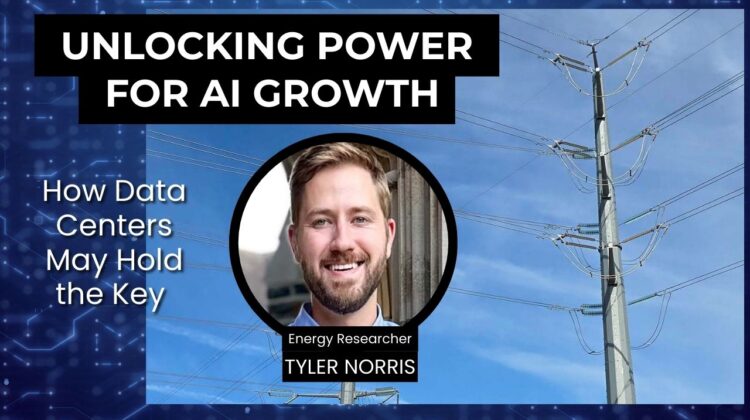
Are regional power grids really constrained, or could dozens of gigawatts of power be unlocked by new approaches to grid management and data center power contracts? That’s the intriguing question posed by new research from an energy analyst, and it could have large implications for the data center industry.
Today on Data Center Richness we’re talking with Tyler Norris, whose recent research paper titled “Rethinking Load Growth” has made waves in the energy sector, advancing new strategies for managing growth on America’s power grid. The research by Norris suggests that close to 100 gigawatts of additional headroom could be created on US grids if data centers can be flexible and limit their power demands for a few hours each year.
Why would data centers want to do that? Because it might offer a faster path to power, which is a huge priority for hyperscale data center operators as they focus on the AI arms race and building America’s digital future. Let’s talk about data centers and flexibility.
Rich Miller. Data Center Richness: . So I wanted to have you on the podcast because you and some of your colleagues at Duke University did a really interesting piece of research about strategies that could unlock power capacity on the grid at a time when demand from data centers has really created constraints in a lot of places. Your work has created a lot of discussion certainly in the utility industry, and I think this is a topic that’s front of mind for data centers as well. We’re going to get into your paper, which is all about load flexibility, but maybe a good starting point was to tell us a little bit about your background in the energy sector and how you became interested in this issue and this piece of research.
Tyler Norris of Duke University: Yeah, sure thing. So I am a kind of mid-career PhD student after having spent over a decade in the energy and electric power space. I started at the Department of Energy where I primarily focused on technology commercialization programs specific to energy technologies. I kind of caught the electricity bug thereafter and so went to S&P Global Platts where I was doing the North American electricity market outlook, so working with our modelers and with a variety of consultants, and most of our clients were integrated majors and very large investor-owned utilities.
From there, you know, the US utility scale solar and storage industry was just getting started and so I joined a large national developer named Cypress Creek Renewables, ended up spending about five and a half years working on development. And so I ended up running a significant portion of the company’s development team, and a lot of my work beyond sort of making investment decisions about projects was working in regulatory proceedings and bringing electricity simulation modeling to bear on the regulatory process, whether it was in integrated resource planning proceedings, interconnection proceedings, wholesale rates, etcetera. And so I gained a much deeper systems level perspective on how we sort of plan and operate the power system.
And then I concluded, I’d love to go deeper and just hone my analytical tool set, so I decided to do a PhD here at Duke University where my research has really been around the integration both of large generators and now large loads. And I think the initial research was motivated by these large backlogs we see in the interconnection queues for generators, but it turns out, you know, the way they studied the generators is basically the same way they study the loads, and so there’s a lot that can be transferred from understanding large generator interconnection to large load interconnection. And so now that we’re in this kind of load growth setting, we wanted to dig into this question of how do we accommodate this large load growth given all the other constraints on the power system?
Rich Miller of Data Center Richness: Your paper takes a look at what you’ve called load flexibility for the data center sector that has the potential to make more power available, perhaps more power available quickly. Time to power is really the holy grail for data center operators right now, and this all kind of flows from how utilities manage peak demand, like we’d get in, say, a winter storm or a heat wave, something like that. Give us a high-level view of your paper and what the sort of central thesis is in terms of how we could get access to more capacity.
Tyler Norris of Duke University: I think one of the key realizations, and maybe even the epiphany for some of us at least, is that we have an intuitive understanding that, right, we plan the system around the peaks. But when you dig into the numbers, it really is shocking to just sit with how much of the power system sits unutilized for such a large portion of the year. And so we really plan around somewhere between, on average, you know, 35 to 50 hours of extreme peaks during, as you said, heat waves or cold snaps, and especially these polar vortex systems.
Outside of those hours, there is headroom available in the system. And so the only solution is that we have to make massive investments in transmission and generation expansion. And when you sit with the numbers and actually dig into it, what you find is that if a new load was willing to be flexible or really curtailable for a limited number of hours a year and not even necessarily going down to zero but partial curtailment, we could add very substantial amounts of new load onto the US power system without needing to materially expand generation and transmission capacity.
There are important caveats there. I think the biggest constraint where you will need to see upgrades is because there are localized transmission bottlenecks. And so we can kind of get more into that. But we have a very large amount of generation capacity already installed in the system because, remember, like we’ve already put in reserve margins of, you know, 15 to 20% on some systems. So if we can kind of figure out the capabilities on the load side and the service constructs that sort of recognize and enable that, then I think, as you said, it could allow these new loads to get online more quickly.
Rich Miller of Data Center Richness: Historically, data centers have always been about uptime and, you know, 7×24, as the name of one of the industry groups is. That is to always be available, so the notion of curtailment is something that there’s probably some questions and some resistance to in some of the data centers who think about their mission. That said, the industry is evolving a lot. There’s a lot of different kind of workloads. Maybe talk a little bit more about what flexibility means and what sort of scenarios we’re looking like and what that might look like for data centers.
Tyler Norris of Duke University: Sure, yeah. And some of this too is we need to better align on terminology, and actually, we were inspired just in part by this US Secretary of Energy Advisory Board paper that came out last July, which recommended a significant research emphasis on large load flexibility, especially from computational loads and data centers. But one of its recommendations is that we need to develop a standardized taxonomy for this because there’s different terminology used in front of the meter, behind the meter, and by a variety of players. So I think it’s when we say flexibility, and by the way, there are different forms of flexibility too, in the sense that you could be talking about at the second scale, at the minute scale, or right at the hourly long scale for the purpose of peak shaving. And of course, you can have ancillary services and frequency regulation and other types of flexibility, but for this purpose, right, we’re really talking about curtailment as you said.
And I think we should include in that backup power and storage that’s on site, and in fact, that may be the primary use case, and it’s certainly the one that has been the biggest focus of discussion, especially in the context of this collocation docket with PJM. And so if we include that in the definition, I think it unlocks a variety of possibilities. So yes, so the first category here is, you know, on-site power or storage. And look, I don’t think anyone wants to run Tier 2 diesel generators that often, although, you know, for emergency purposes, that’s why they’re in place, right? So there is that option. Of course, you’d prefer that it be cleaner, so whether it’s Tier 4 diesel or natural gas or other cleaner fuels, or of course, some combination of battery storage or other types of storage. I’m hearing a lot of interest on thermal storage applied to large loads and data centers, so that’s an exciting opportunity. But, you know, that’s the first category.
The second is temporal shifting. One of the key aspects of the AI specialized data centers that we think could make them more flexible is that the workloads are more batchable and deferable than traditional real-time on-demand cloud computing. And so if you’re able to time shift those even by a few hours, because these peak events, right, we’re talking about on average, you know, two to five hours in any given system, so if you’re able to frontload or defer that workload by a few hours, that could be the thing that unlocks the capability.
Other, of course, for the sort of hyperscalers that operate, own, and operate multiple data centers, is spatial flexibility, so being able to shift a computational workload, and likely in particular training workload, from one data center to another in a region that’s not experiencing the same contingency event. That’s an option.
And then, you know, the fourth category is reduction in operations, which obviously is not very appealing for the data centers. We know it’s appealing for the other computational loads like cryptocurrency mining, and so they’re now one of the most flexible loads on the system. But even we should, I think, recognize for some of the data centers there is some possibility there when you think about, I think, especially the differences in seasonal load requirements, especially for cooling loads. And so the possibility that in the wintertime, especially during, you know, extreme winter weather events like polar vortexes where, you know, it might be 15 to 20 to 25 degrees out, you know, you should have less cooling load, and we see that in the data, by the way. The data is limited, as we all know, but you can go right now look at Google’s quarterly PUE reports, and you can see there is variation between, you know, the winter quarter and the summer quarter, although if you were to zoom in even further right on the most extreme weeks, I think you’d see even more variation. So I think that is even a possibility for some of the data centers.
Rich Miller of Data Center Richness: So like at a time when data centers need less cooling because it’s cold outside, say that, that would create some headroom for them to be able to say, well, during this time period, we’ll need less, we’ll use less, and then that would then improve the math for the grid in terms of its peak numbers.
Tyler Norris of Duke University: That’s right. And I think the critical distinction here between traditional demand response programs and what we’re talking about here is that, like an existing data center could already do that, right? If they’re in a market that has a demand response program, they could decide to participate and essentially bid in that as capacity, that flexibility as capacity, into an existing demand response program. But the issue is that if it’s an existing load, whether it’s a data center or any other load, right, by and large, all of those loads have been planned as fully firm loads, right? So for the purposes of the interconnection study, the transmission planning study, and the reserve margin planning, you’ve planned for them as firm loads. Basically, you haven’t recognized their potential flexibility. And so you have invested in all of the firm capacity necessary to serve them at 100% of their maximum peak nameplate draw in all hours of the year.
And so what we’re talking is really pulling this up into the planning realm so that you can recognize that potential flexibility upfront. And of course, that could be primarily on an interim basis, right, so that a new load could get online more quickly, and then over time, right, once the firm sort of upgrades are in place, it could upgrade to a fully firm load. But yeah, so a variety of potential arrangements there, but that’s the thrust.
Rich Miller of Data Center Richness: Yeah, it seems that the ability to think creatively in terms of the agreements upfront and structure them. I know we’ve seen examples, and I don’t know if this is the same concept or slightly different, where, for example, in Texas, some of the large cryptocurrency outfits for a while had agreements where they could curtail. I think some of them were even compensated for that, and that, you know, there’s some firms down there that work that, you know, use software to help manage that for them. But crypto is generally curtailable in a way that most data center workloads are not, particularly when we’re talking about cloud or traditional enterprise workloads. I think the AI, and particularly training, does introduce some opportunity there because some of those could be curtailable, or there could be like gaps where they’re upgrading, you know, software, hardware, or something and they might be offline. So a question is whether in terms of curtailment, whether that is guided primarily when the grid is experiencing peaks or could it be built around times when the data centers might be able to adjust their requirements, because the timing there matters if it’s like something that can be planned or something that just comes up and has to be adapted to in real-time. What’s the, what do things look like there?
Tyler Norris of Duke University: Yeah, that’s a really great question. So I think what would lead to the least necessity, right, in terms of tapping this flexibility capability, would be if we view this more in terms of an emergency service, essentially where we are expecting a potential mismatch, right, between aggregate supply and aggregate demand because we’re experiencing, as you said, a heat wave or an extreme winter weather event. And one of the, you know, one of the good news items here, right, is and thanks to AI, we are much, much better at weather forecasting than we’ve ever been, and we will continue to get better. And so that actually, by the, when people ask what is the, what is the best use case right now of AI in the power sector, my response is in forecasting, especially for weather. And so especially with like a polar vortex event, I mean, we can, we can start to see, you know, the trend even a couple weeks out, but certainly within a week and then several days in advance, right, we can see it coming. And so that can be planned around.
And so I think usually, you know, in a demand response program, like the longest notification window you might have would be like, you need to give them one day’s notice. I think for the most significant types of events we’re talking about here, that is what we’re talking about, and so I think that is where the most value is and is something that the data centers could be given notice about so that they can plan in advance as to what is the best way to sort of reorient their workloads.
That said, there is significant value to the extent, of course, that a load could offer those services in real-time, and that does open up other value streams. And so that’s like, you know, ERCOT’s controllable load resource where you essentially can be given a real-time signal from the operator. And so there are other value streams there, and to the extent that, you know, a computational workload is able and willing to do that, I think we’re seeing all sorts of innovation happening right now. There’s a startup called Emerald AI, and they’re actually going to do a significant unveiling, I think, in mid-May, and they’ve developed some really interesting advanced computational resource management techniques that would allow, I think, a data center to receive a real-time signal and adjust its computational workloads with minimal or no impact on service quality. And again, the way that ends up working is that you’re deferring certain workloads that can be deferred.
And it even seems to me likely that we could see an evolution in the way some of the service level agreements are structured such that, you know, this is an option to the user even for inference workloads for neural nets. Right? So I’ll give you an example, right? I don’t know if people go on ChatGPT right now, they have a relatively new function where you can ask it to do, you know, a deep research task, and it will come up basically with a little research paper within, you know, 10 to 20 minutes. And, you know, one just very simple option you can imagine is that let’s say you’re about to run off to lunch and you want to, you know, you want to give it a little bit of a research task, and you say, you know, I, I just need this within a couple hours, right, instead of within 15 minutes. Or even right, you want it to go so deep that, you know, you give it the task at night, and you say, I don’t need this until, you know, midday tomorrow, and you can indicate that as a user upfront. You could also imagine that that ends up being structured into price signals, right, both to the users as well as to the, you know, the data centers themselves. So I think there’s a variety of, you know, possible innovations we can see in how these are structured.
I do want to say one thing about how we talk about this from like an uptime requirements perspective because I do, I have found that there is significant uncertainty and misinterpretation about what we mean when we say there are high uptime requirements. So, you know, let’s first distinguish between what we would call the utilization rate of the overall load, in this case, the data center, with respect to its nameplate interconnection request to the system operator, to the transmission provider. And when you look at it from that perspective, so what is the overall utilization rate for a data center compared to its max nameplate capacity, it’s quite low. And the number, so we don’t have data, that’s not enough, but the number that Lawrence Berkeley Lab uses in their recent data center energy usage report is 50%. And what I think we’ve seen historically has been this tendency to oversize on the nameplate rating that is submitted to the utility, in part because there was more headroom on the system, there wasn’t as much concern around, you know, interconnection delays, and frankly, in some cases, this was a bit of a symbiotic relationship, I think, between some large loads and the investor-owned utilities who, of course, you know, they enjoy the rate basing opportunity for additional capacity, and, you know, that, that’s kind of an arrangement you might see where you’re long on capacity, you don’t have constraints, but we’re obviously moving into a different world.
So that’s the first thing. But then so when people say 59s, it’s like, well, what are we talking about? So what we’re really talking about, as you know, is the customer-facing guarantee, right? It’s not that the servers are actually running at 59s, right? Like, in fact, you would not want to operate the servers at 99.999% capacity because they would overheat, and actually, they become less efficient. And so we don’t have certainty, this also varies, right, from chip to chip, but you might actually be operating the server at like 60 to 70% on average of its maximum potential draw. So there are all these kind of like layers of, I think, headroom in the system that can be moved. And then, of course, you’ve got the cooling loads, right, which also fluctuate. So I think there are a variety of like pockets of headroom in the system at different levels. And I think this is just a great opportunity for some of the data center owner-operators is to sort of figure out, okay, like we have this headroom, how can we actually plan around it and get credit for it with respect to our transmission provider, you know, first and foremost as you said, from a speed to power perspective, but, you know, possibly beyond that.
And I know right now it’s like the willingness to pay seems so high, and it seems like no amount of demand response revenue could move the needle, but it does seem like we’ll probably see some rationalization in the market. And I think, you know, the extent of some of these demand response price signals in certain markets that are capacity constrained could be quite substantial, especially by the way if they send a signal with respect to like the loss of load probability increase that could occur if in fact the system doesn’t respond with capacity expansion. So, yeah, I think it’s just helpful to like clarify a few of those few of those pieces.
Rich Miller of Data Center Richness: Yeah, and I think on the utilization front, I think there’s growing discussion of the fact that some data centers will have headroom, they’ll have underutilization. Now, I think there’s different use cases there, sort of to try and dig into that a little bit, between the hyperscalers who are very focused on getting the most out of every piece of hardware, every bit of energy, they run at much higher utilization rates than you would see for like a multi-tenant collocation provider who, you know, because what they’re doing is they’ve got lots of different customers operating within their data center, they will vary their loads and don’t have to get clearance about what they’re doing. They’re like, we’re doing our business, the loads are going to go up and down. It’s hard to say, well, we’re going to utilize that underutilization because you never know when one of the customers might want to use it and because there are the service level agreements, particularly there. But there’s more discussion of that, I think, is the short way to say it. There’s even some services that have said, “Hey, we’re going to operate in that headroom area by being curtailable within the data center where it’s like for, they’ll run a cloud service that says, ‘Hey, we’re going to have fewer nines so your jobs will be curtailable, but you’re going to get a better price because of that.'” So that’s some of the thinking in there.
And I think the big thing is what data centers are always looking at is risk. What’s the risk of the unanticipated events? When you listen to the engineers do like a Q&A on presentations at data center conferences, everybody’s always trying to imagine the worst-case scenario that they may not see coming and prepare for that. And I think that’s one of the reasons why they like the flexibility so much. But you mentioned about the AI and data, and I think one thing that’s true for both data center operations and grid operations is that as we get more opportunities with AI and with software, that over time maintenance and our understanding of these systems and the ability to manage them more granularly seems like it’s going to get better.
Tyler Norris of Duke University: Yeah, so many great observations there and things you could unpack. But one point that I think is important is that when we say we lack the data to understand, you know, say what the specific load profile of these AI specialized data centers are going to look like, it may be that even the owner operator doesn’t quite know, right? Because we don’t know exactly how this market is going to evolve, what the demand will be both for training workloads and inference loads, and you know, what time of day they’re going to peak and what that looks like on an interseasonal basis. So it is understandable, you know, if you’re a developer in that context, and by the way, I used to be a developer, so I completely understand the orientation towards maximization of optionality, right? Like you always want the option to expand where you can if you can, and so if you can preserve that option at zero or low cost, you of course always prefer to do that.
But I do think especially when we look at this, you know, we’re talking about a limited number of events in the year, these are for primarily emergency responses and contingencies events, it does seem to me that we can plan for some amount of flexibility. I mean, especially if it can be demonstrated that that flexibility can be provided with minimal or even no effect on the service level arrangements, because as you said, they’ve already been designed to account for some degree of flexibility or because what we’re talking about here really is partial curtailment with a mix of on-site power and storage, and you know, some advanced computational resource management techniques, again, that involve a little bit of deferral of deferable workloads. So I think there’s probably going to be a mix of applications there, but I think what ideally it can add up to is that you can account for some of this flexibility in a limited number of hours of the year with expected minimal impact on quality of service.
Rich Miller of Data Center Richness: So in terms of the sort of incentives for data centers here, in a scenario where there’s a peak and more power is needed, hypothetically, the data centers would then go to backup generators, something like that, have some warning, X number of hours, where they can say, “Here’s where we’ll go to generators.” So is that accurate? And then on the flip side, what’s the sort of carrot for data centers to agree to this, participate in this? Is it access to power, access to power more quickly?
Tyler Norris of Duke University: You know, I’m glad we’re having this conversation today because just a few days ago, it was the deadline for intervenor comments in FERC’s PJM collocation proceeding. And all of them are worth reading. I mean, there’s over, there’s nearly 40 sets of separate comments, but many of them are tackling this exact question: what are the adjustments in transmission service that need to be made to account for exactly this kind of flexibility that we are talking about? And some of the comments hone in on this ability to get faster speed to power.
And so just, just so we’re clear on why that would be the case, it may sort of go without saying, but if you’re accounting for a new load as 100% firm, that automatically sends a variety of signals to the system operator and the transmission provider that says, “Okay, we need to in our planning studies account for this new firm load, and that means that during the worst contingency event that we forecast, this is going to be also pulling from the grid at 100% of its nameplate capacity.” But it’s even worse than that, Rich, right, because they’re also looking at all these contingencies applied on top of that, right, including N-1 and even N-2 conditions layered on with these local stress scenarios. And so that automatically often triggers the need for a variety of both network upgrades and the need for more generation capacity from a reserve margin standpoint.
But of course, if from a planning perspective they’re able to recognize that flexibility, because right, these are generally like single snapshot what we call steady-state studies, right, so they’re looking at their forecasted maximum peak at some point in the future, but if instead they can say during those most extreme conditions we can anticipate this level of reduction of grid draw, then that could translate to meaningful deferral or even avoidance of certain network upgrades. And especially, you know, if we’re talking about the need in particular to avoid having to reconductor or and/or rebuild an entire transmission corridor, right, I mean, those, as you know, those costs mount so quickly, and, you know, now it’s up to like $2 million a mile, right? And so if we can mitigate or defer those upgrades, that could allow for faster speed to power.
And the same principle applies, you know, to the need for sort of reserve margin generation. I think that’s, that’s one of the, the sort of key incentives, but I, I also think a lot, you know, more and more markets are going to be thinking about other possible price incentives, but also ways of thinking about this in a different way. So I just give you one example, which is, you know, when NERC came out with its long-term reliability assessment late last year, the headline in Utility Dive was, “New NERC report suggests half the country could be at risk of blackouts by the early 2030s due to new load.” And I mean, that’s a shocking headline, right? It’s, I mean, if, if you didn’t know a lot about, I mean, that would be a very, very alarming headline to see. And you should ask, well, what’s going on here? So how is it that addition of a new load might increase blackout risk for existing load? And what’s really going on there is that you’re assuming that all the loads will be treated equally essentially from a load shedding perspective, right?
If in fact there is a mismatch between supply and demand, something’s got to give here, right? Either we just will not be able to incorporate all this new load because we cannot build out this transmission and generation capacity quickly enough, or the new load is going to have to sort of contribute a little bit in terms of grid services that could mitigate this. Or the other possibility is that, well, there are a couple ones. One is if in fact you have load shedding such that tens of thousands or even millions of residential customers are curtailed, load shed before a large commercial customer, I mean, I, I think you’re going to see a very severe backlash that is not going to be great for the industry. And so, you know, I think taking a little bit of a proactive posture on this, trying to get ahead of these, ahead of these kind of backlash scenarios so that we’re making sure the system is reliable and not imposing unreasonable costs on existing ratepayers. And, you know, there are a number of tools in the toolbox, but I think limited amounts of flexibility, you know, for 50 hours or so a year, is one of them.
Rich Miller of Data Center Richness: Yeah, I think on the data center side, it’s been pretty clear that time to power being the priority that it is, particularly for the hyperscalers, it seems pretty clear that some folks are willing to pay for that. There’s also scenarios in markets where folks need power and there’s really none available, that investment in supporting infrastructure is something we’ve seen agreements in a couple of states that are essentially asking for some sort of commitment either in terms of being able to share the investment in transmission and substations or to guarantee service that you’re going to use these assets for a certain amount of time. There’s a lot of different scenarios that are getting tossed out or implemented in certain states. I’m curious how much of an opportunity have you had to speak to folks in the data center sector about what they make of these strategies and what their concerns are or what opportunities they see in load flexibility?
Tyler Norris of Duke University: We have heard a pretty clear signal that if these service agreements and tariffs could be established that you get this clear, quantifiable, and reliable tradeoff between speed to power and flexibility, that that would be of interest. And, you know, in recognition of some of the challenges here, it is in fact the case that those service level arrangements don’t exist in most markets, right? Like this is a different paradigm of system planning than I think we’ve really encountered before. And so where we do see it, right, is PG&E’s Flex Connect program, which is primarily distribution scale focused, and I think, you know, the initial uptake there is primarily around, you know, large EV charging stations. Southern California Edison has a similar approach, and to some extent, you know, ERCOT’s controllable load resource program. But the options aren’t in place, I think, for the new loads, and that’s exactly what several significant interveners clearly state in the PJM collocation docket and their comments last week.
And so it seems likely, and you know, PJM itself proposed a variety of new transmission service tiers that would try to get at this. I think there’s still some steps to connect it to the interconnection study itself and how that relates to sort of cost allocation. There are several comments that get at this, but I think one that lays it out perhaps the most clearly is Enchanted Rock’s comments in the proceeding. This is exactly the opportunity their company’s trying to go after, right? And in their case, right, it’s primarily on-site natural gas, and so they want to help their customers, these large loads, be able to get online more quickly by mitigating the need for immediate network upgrades. It’s sort of, you could also call it kind of a bridge power solution, right, until the firm upgrades are done. But the service contracts don’t yet exist, and so I think it’s in everyone’s interests to get, at least from a voluntary standpoint, these contracts established as quickly as possible so that this can be an option for those that want to use it.
You know, your question was more broad as to sort of how people are reacting. There is a significant distinction between, I think, the hyperscalers and the collocation data center owner operators. And we’ve certainly seen more interest especially from one or two of the hyperscalers in this kind of flexibility, and they’ve even sort of publicly advertised that capability. It’s hard to say why exactly they’ve advertised that capability, but I think one is that perhaps they do perceive some degree of comparative advantage, right, and that if they are able to offer this as a service to the transmission providers and the operators in a way that allows them to get online more quickly or have other sort of preferential status, that that could be a source of competitive advantage. I’m not in the, I’m not a market participant, but if I was looking at that, I’d say, okay, so, so maybe this is a reason why we should exploit the capability.
At the same time, I do think there is this hesitancy to advertise that capability because, well, first off, you want to get, likely want to get compensated as much as possible for whatever, you know, capability you may be offering, so of course the way you start a negotiation is not to necessarily say, you know, this is the capability that we can offer. You want to sort of have a bilateral negotiation where you can sort of see how far you can get. I mean, I think the other is that this is, this is relatively new, and I think even from the financing counterparty side, I empathize with those that are developing these these assets because I do think like the financing counterparts, I think they just look at a product and they say, is it firm or not, right? And they don’t, they don’t really understand what does it mean to be non-firm or quasi-firm. Like, this isn’t a product they’ve banked before. I think it is similar to just like the evolution of a variety of markets, and we need new contractual sort of innovations. And it’s sort of like the evolution to, you know, virtual power purchase agreements, right, which like didn’t exist at one point. And that’s why my, my hope is that like we can demonstrate a few bankable products and even if it’s just purely like speed to power on a purely interim basis, right, from a bridge power solution, so that we can get the contractual innovation, get them banked, and get the financing counterparties more comfortable with this approach so that it could then potentially proliferate more broadly.
Rich Miller of Data Center Richness: Yeah, and I totally think that would be of interest in terms of like a bridge power arrangement. The whole idea about the speed of change and how quickly things can begin to shift and embrace the new challenges in the market is an important topic. You mentioned a couple points, the proceedings that are undergoing with PJM, and as best I understand it, it’s really about what the ground rules are for on-site collocated power, how all the interconnections can work, who bears the cost on that. Is that roughly correct? And do you see this as an opportunity to bring some change and to shift the paradigm about how the power and data center industries work together?
Tyler Norris of Duke University: Yeah, you know, it’s very, very quickly evolving. So I think initially this proceeding it seemed to be more limited in nature because it would, I think people were thinking about it as this, this scenario, right, where you have an existing generator that’s serving a given power market, a load comes in sort of behind the meter on that existing generator and takes it offline or largely offline. And that’s what kind of triggered a lot of concern about this, right, because this notion of like, we might be taking existing capacity offline from existing to serve dedicated loads. I think it’s expanded substantially beyond that, and in part because of PJM’s own response to FERC’s prompt. And what they ended up laying out was, I think it was eight different transmission service products, three of which they already offer and five of which would be new, and they account for a variety of different possible what you could call collocation arrangements and everywhere from existing generators and loads to entirely new ones.
I think this is kind of the tip of the spear right now. I don’t know of any other proceeding that’s as advanced as this one, and it’s all kind of breaking in real time. So I encourage everyone if you have the time, go and at least read a summary of some of the comments because I think where this is, this is going, is illuminating the need for more of these types of services and options for the loads. And, you know, I think if you’re a data center owner operator and you’re kind of worried that this could evolve in a direction that could be unfavorable, then it behooves you, I think, to get involved and try to sort of shape this in the right direction. I don’t see why anyone would be concerned as an initial starting point to get on a voluntary basis the the product set up for those that may want to use them.
In some other jurisdictions that, I think there is interest in going beyond simply sort of voluntary service offerings. And one of those that has been noted is that, you know, Duke Energy did come out at a public event about a month ago and say that they were going to start requiring new hyperscale loads, which they define anything above 100 megawatt, to participate in demand response. And the representation there is that there are definitive agreements that have been executed by data centers to those terms. And we don’t have the details of the terms, so we’ll, we’ll sort of see once those are released. But, you know, and look, we’re hearing interest from a variety of other regulators and and trying to figure out something like that. But we don’t take a position on whether it’s mandatory or voluntary, it’s more just about getting the option in place so that it, it could be utilized to the extent that there’s, there’s capability.
Rich Miller of Data Center Richness: Listen, I know you’re tracking this very closely for our folks in the data center industry. We’ll certainly include a link to your paper in the show notes, so everybody look for that. I know you were posting about the FERC proceedings just this morning and you’re tracking all of this, so where can folks find you if they’re interested in keeping up?
Tyler Norris of Duke University: Yeah, sure. I’m on LinkedIn, you know, Tyler Norris. I always have to clarify that there is another Tyler Norris who I think participated on The Bachelorette, so they have a pretty high ranking. That’s not me. It’s Tyler H. Norris, and I’m at Duke University. So that’s probably the easiest way to find me. And I do try to post relevant sort of ongoing content, but also, I’ll just say from a research standpoint, if you’re interested in this topic, the analysis we put out in our paper, we considered a first-order assessment that was necessarily simplified. And so we’re going much deeper right now, looking at a couple key markets. And so we’d love to talk if you’re interested in that research and modeling and so that we can sort of incorporate your perspective.
Rich Miller of Data Center Richness: Tyler, thanks for being on and talking with us, and thanks to everybody for listening. If you enjoyed the conversation, hit that like button and be sure to subscribe to the Data Center Richness podcast so you can get more of these kind of data center insights. Thanks so much, Tyler.
Tyler Norris of Duke University: Thanks so much, Rich.
