
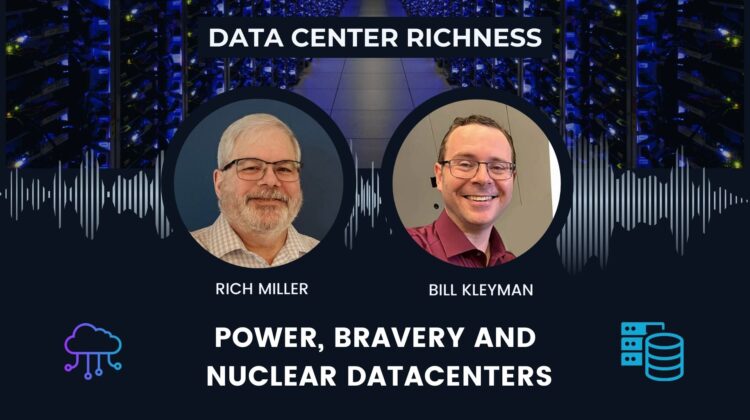
In the premiere episode of the Data Center Richness podcast, host Rich speaks with Apolo CEO Bill Kleyman about his mantra of “power and bravery” as the key to innovation and building the data center industry of the future.
A key focus is the timeline for nuclear-powered data centers. How soon can nuclear energy be available to address the “power gap” from constraints on regional power grids? Rich and Bill discuss the varied approaches to nuclear data centers – including traditional nuclear plants, small modular reactors (SMRs) and even portable microreactors that can be deployed on trucks – as well as the interest from tech titans like Microsoft, Google, Amazon (AWS), Meta and many others.
Kleyman says nuclear-powered AI infrastructure may arrive sooner than expected. He will moderate a keynote session at the Data Center World conference featuring Google and nuclear specialist Kairos Power, who hope to have a nuclear project online by 2030.
Kleyman also talks about the importance of introducing data center careers to younger students, and his experience with immersive learning programs. And Bill has lots to say on his theme of “power and bravery” as the key to innovation and building the data center industry of the future. Here’s an overview of the discussion between Rich Miller and Bill Kleyman.
00:00 Introduction to Data Center Richness
00:21 Meet Bill Kleyman
00:41 The Outlook for Nuclear Power in Data Centers
02:38 The Growing Demand for Clean Energy to Power AI
03:49 The Rapid Evolution of the Data Center Industry
05:38 Practical Deployment of Nuclear Technologies
14:46 Staffing and Workforce Development
17:47 Inspiring the Next Generation
23:30 Power and Bravery!
At Data Center Richness we demystify technology and explain why data centers matter, and what comes next for the Internet, cloud computing and AI. Host Rich Miller is a journalist and analyst who has been covering the data center sector for 25 years.
Podcast Transcript
RICH MILLER: Two of the largest challenges in the data center involve scarcity. The constraints on electricity to power the internet and the staff to manage data centers and AI infrastructure. On this edition of Data Center Richness, we’ll look at solutions for both these challenges with our friend and frequent colleague, Bill Kleyman.
I’ve worked with Bill at Data Center Knowledge and Data Center Frontier, and Bill is currently the CEO of Apolo, an AI platform and infrastructure company. Many in the industry know Bill as the program chair for Data Center World, one of the largest industry conferences. In our conversation today, we explore how nuclear power has become a key priority for the data center industry and the focus of a keynote panel at Data Center World, which Bill will moderate.
As a millennial on the front lines of data center staffing, Bill also shares some insights into how we build the workforce of the future.
RICH MILLER: Bill Kleyman. Welcome to Data Center Richness.
BILL KLEYMAN: Thank you so much for having me here. For those who have seen me and have met me, great. You understand this level of energy. And then for those who have not, I promise this is natural.
I’m actually not drinking any coffee anymore. This energy is all for my newborn who’s hopefully sleeping right now in the other room. I am Bill Kleiman. I’m the CEO and co-founder, of Apollo. You can check us out at Apollo.us. We entered this market in 2023 as a very unique player.
We are the industry’s only true multi-tenant, white-label MLops platform. If a data center wants to deploy true AI as a service capability, not just like a GPU by the hour, they reach out to Apollo because we do full multi-tenancy , billing, integration, ticketing, technical backend, CRM, all of that. So you literally give your customers a chance to do AI where their data lives.
RICH: One of the many hats you wear is that you’re the program director of the Data Center World conference, which has been one of the prominent trade shows in the industry for many years, and you’ll be moderating a panel all about nuclear energy and data centers.
That’s an interesting topic, because just three or four years ago, nobody really wanted to talk about nuclear energy in the United States, and then some folks in the data center industry began whispering about it. But over the past couple of years, suddenly it’s become kind of front of mind.
So I’m interested in your take on how the growing interest in nuclear energy has evolved over the past few years.
BILL: This is an extraordinary topic. To be successful in the industry right now, you need two things, power and bravery, right? A whole lot of bravery. And that’s super contextual, right? You come to terms with what that bravery, ultimately looks like.
But we’ve seen everyone from Digital Bridge and all of the big financial organizations and their leadership come out and said that right now, the biggest barrier to entry into this market – this ai, this high density compute – is power, right? There’s just simply not enough of it.
And where we’ve got something between like 4 and 8 gigawatts under construction right now, the demand is about 5 to 6 times that, if not more from all of these facilities all over the world, and especially here in the United States. I’ve been in this industry for 20 years. What I’ve seen happen in 24 months, eclipses those 20 years. That’s how fast this industry has been moving. So the challenge becomes pretty existential when we don’t have enough power.
We don’t necessarily want to start spinning up more coal-fired plants or looking at dirty energy. We need to look at clean energy as a real viable option. And this massive acceleration of the adoption of these technologies really has happened on a multiple multitude of levels.
And here’s the progression. Just a couple of years ago, this topic of conversation around nuclear technologies was, ‘Bill, we love your energy. We think that clean energy is where it’s going, but you’re talking like 10 to 15 years from now.’
And lo and behold, on the keynote stage (at Data Center World) it’s gonna be Kairos Power, and the head of Google’s clean energy and decarbonization. But this isn’t a project for 2040. It’s not a project for 2035. This has a go live date for 2030.
We just spoke with the C-level folks over at Dominion Energy and they’re doing SMRs too. And these are going to be supporting large hyperscale environments as well.
When we start to see traditional build outs, actual land acquisition sizes of a hundred megawatts or more becoming normal, that’s insane. That’s an extraordinary amount of power that we need to be able to deliver and the reality of the situation is that a lot of the market is starting to adapt rapidly to the more emerging critical solutions where we’re grappling with these power constraints.
It’s almost an existential situation. The specific project that we’re gonna be talking about is that in October, 2024, Google signed an agreement with Kairos Power to purchase upwards of 500 megawatts of nuclear energy via PPAs, and the very first planned reactor deployment is gonna be in 2030.
And it’s extraordinary how fast this has come. There’s been growing Government support. Right? And this is not a political statement. We’ve seen multiple administration say that we in the United States have to create power security, right?
We have to create an architecture where we can support the growing elements of AI. And multiple administrations certainly don’t want to get lapped by China and others, who are also investing very heavily in artificial intelligence and developing of these systems.
So now you have government support. And then last year at Data Center World we had a half day workshop on it. We had people from INL, Department of Energy, , and the conversation was not ethereal. It was not “these are so cool, they’re not gonna melt down, this is how much it costs.” It was “Here’s how you get a permit. Here’s how you overcome objections. Here are the grants available from the government. Here are the facilities , and folks that are licensed to build these things and how they’re gonna be built out. Here’s what waste disposal looks like. Here’s how you work with communities and people in that local area. “
So practical deployment strategies of these technologies are happening now. Five years in this industry is a blink. One of my board members, Peter Gross, always says that the data center industry loves innovation as long as it’s 10 years old.
We don’t have 10 years anymore. We have like a blink of an eye.
RICH: Obviously, speed to market has become a major issue.In fact, it’s probably the primary issue for many of the hyperscalers who deploy all of these new technologies, which require massive compute at massive scale. And yet we also have so many of the areas of the country where there are power constraints, which is why folks are looking at new approaches to energy, including nuclear, uh, which is of interest because they want something that’s net zero.
And the availability of wind and solar is a challenge at the moment. I made a list of some of the projects that have been announced where companies are looking at nuclear energy or working with nuclear technology companies. The list includes Microsoft, Oracle, AWS, Google Meta. And even some of the multi-tenant providers like Equinix Switch, Sabey and Endeavor, which owns Edged.
So there are a lot of irons in the fire here, both in terms of tapping energy from retired nuclear plants, such as in the case of Microsoft’s deal to buy energy from Three Mile Island. As well as working with the small modular reactor companies and virtually everything in between. One of the interesting things about the data center industry is that we’ve seen lots of folks coming from the nuclear submarine industry, and most of these folks, of course, think nuclear micro reacts are safe.
So in terms of the landscape for nuclear. It seems like there’s some work on the short term, trying to work with the existing infrastructure and existing nuclear plants, as well as this other future technology piece involving small modular reactors. How do you size up the way that the data center operators and their customers can think about, um, how nuclear fits and when it arrives?
BILL: This is an existential moment in our industry and the conversation we’re having is not a nice to have. That’s really important for folks to understand.
One of my partners, for example, Scott Data Center out in Omaha, Nebraska, heard me speak at Data Center World and then they’re traditional colo, and all of their customers are enterprise, no hyperscale.
And they want to capture this AI business. Right? They deployed Apolo. But what theyalso did is they went through that that power and bravery journey, right? They were a traditional air-cooled facility, and they went from 10 to 15 KW per rack – which is not bad – to 70 to 80 kw per act by putting Motivair rear-door heat exchangers, really increasing the density, and creating this extraordinary architecture that could all of a sudden handle AI. But they went on a journey.
How much air can dissipate heat from mechanical equipment? I am not saying air flow is going away by any stretch of the means, but we have to adapt. Let’s convert that to power this conversation around energy. You have to adapt. And it’s not just nuclear, Rich and everybody listening. In western Texas, Yuval Bashar from ECL is doing a hydrogen architecture out there, and I asked him, Yuval, how, how do you make this economical?
He’s like, “Buy the whole supply. Buy the whole pipe, cut out the middleman, get the entire hydrogen into my facility, and all of a sudden it becomes affordable.” In eastern Arkansas, I believe there’s a 100 megawatt natural gas turbine project going on for a data center. So it’s not just nuclear.
Rich, I’m gonna challenge you a little bit more. From the colo side, from traditional data centers and yes, from hyperscalers. This is not the end of these technologies.
There’s a really cool nuclear system. They’re called Radiant Nuclear. If you haven’t heard of them, holy cow, check ’em out. They are generating electricity of just shy of two megawatts of nuclear power. And their goal is to replace diesel generators in all these remote locations for hospitals, for military installations, and for data centers. So imagine for a second with me. It’s a little SMR two megawatts that fits on the back of a semi-truck. They bring it, they park it, you run it, and then when it’s done, they put it on the back of a semi-truck and they haul it off. No waste, nothing in the ground, nothing permanent, and effectively replacing, let’s say dirty diesel generators with this new kind of clean technology.
Now what you’re talking about is primary power, right? Okay. How do we get this into the facility? We’re starting to see the trickle-down effect of what else can we use this for? Where else can this be applied? And the reality of the situation is the acceleration of these technologies and the willingness to adopt them. That’s been the biggest change in this entire industry.
When I worked at Switch, for example, we would get land, we would have to get power and we would scale, right? Well, none of that’s changed, but what has changed effectively, is that the servers, the systems that we’re dealing with, they’re not pizza box servers anymore, right?
It’s no longer email and SQL and exchange and VMware and virtualization. These are beefy boxes. One single DGX node of H100 (NVIDIA GPUs), so eight cards in one of them, it’s 10.2 kilowatts per rack, right? My partner’s got six of them in one rack and multiple rows. That kind of density requires obviously a clean load of power that’s not always available.
I was always a proponent in talking about these technologies, these nuclear solutions coming to our market sooner rather than later, and I absolutely believe that’s what’s happening now. Getting up on stage and hearing Kairos discuss what they’re effectively building is a big deal. That’s gonna be a wonderful use case. And right now we’re seeing more and more of these technologies get licensed. We’re seeing the Department of Energy and we’re seeing folks from the government obviously open up how they work with these systems. The acceleration of licensing, for example, the easing of restrictions. All of this to help us both be more competitive as a nation, but obviously to support everything that we’re doing with artificial intelligence. And if you’re sick of hearing AI, ChatGT, all of this stuff, I’m sorry, not sorry.
This is literally how many organizations are figuring out how they’re gonna revolutionize their business, how they’re going to capture something that’s truly finite – time. That’s what these AI systems ultimately give back to us, and none of that is slowing down.
So to answer your question, how soon? Five years for me is an extraordinary benchmark of where we’re gonna see live SMRs running and operating for a hyperscaler. That’s crazy. Five years.
RICH: I think we’re in what I call a now and later scenario where many data centers are looking for short-term bridging solutions, often with natural gas. And so natural gas is the now solution for people who need really large scale. And then the nuclear technologies, , assume the role of the “later” energy source.
BILL: That’s why microgrids became very, very popular. Right out of, out of nowhere, you have this really cool aggregation tool. That can look at multiple sources of energy and actually allow you to, to use different, different sources of power, basically, to deliver that to a facility.
But you’re, you’re absolutely right, the diversification of power has been happening in our industry very rapidly.
RICH: I want to follow up a little bit more on the staffing and personnel challenge, uh, because this is a challenge that’s only going to grow over time. Lots of guys in the industry that look like me have a little bit of white hair, but because you’ve worked pretty closely with students and with some of these career outreach programs, what do you see that’s working?
BILL: Immersive learning is working, so with, the JS program between Nomad Futurists and Infrastructure Masons.
So, the JASON learning program is a partnering program of ours. And what they do, , is they take groups of students, from high schools and. They, like, let’s say a student says, , I wanna work in manufacturing. They’re gonna put this student in a manufacturing plant for like a month or two, right? Or this person says, I wanna work in a hospital, or I wanna work in farming. So immersive types of learning. Um, and so what’s working right now
Instead of like Bill Kleyman drinking a cup of coffee or coming up as Energetic Chipmunk talking to a group of students, that doesn’t work.
It might inspire a couple of people, but what really does kick in is having a conversation with educators, telling them how their student body can be involved, offering internships. For example, there’s a school here nearby in Chicago, the Bennett Day School. We offered an internship one-on-one, their students, it was 18, and he came to work at Apollo to do like things like ML and data sciences for data centers.
But that’s not to say that that’s the only one, one of my students that I mentored now, she works for Edge Connects. She was an electrical engineer up on stage.
When I had her talk to me, she’s like, Bill, I would’ve never done this. I never in my life. Thought that I could apply my skillset and what I’ve learned to this industry. But now I’m here designing power infrastructure for distributed environments and it’s so freaking cool. Back to the point, what works?
To get to these students, you have to be immersive. You have to speak their language. Um, and what’s helped us. Industry-wise is that data centers are mainstream. Pick your favorite news channel We’ve been talked about. South Park did an episode on generative AI called “Deep Learning.”
It was scary and it was amazing. People looking at that are gonna ask the question of where it lives. That’s been a big, big element. The other one that we’ve learned about, and this is a kicker, is that we can’t start at the college level anymore. We go talk to the students, we talk to some of them. A lot of ’em already have an understanding of what they wanna do.
And yes, I have a lot of energy, I have a lot of passion. I do genuinely love this industry, and you know, that shines through, but we’re seeing more of that penetrate into that, that school, that elementary, that junior high school level.
It works. It gets their brain going. It gets them introduced to STEM programs, understanding where could they can apply their skill sets because electrical, mechanical, civil, computer engineers all have a future in our space. I remember a civil engineer came up to me, it’s like, bill, you, you think I can work in a data center?
I’m like, we need roads. We need pipes, we need water coming into this thing. I can’t build this stuff. There’s literally pipe and supply companies out there that solely focused on digital infrastructure where you can directly help. And for them it’s, it’s eye-opening. It’s so cool.
RICH: So Bill, when you work with younger students who are in, uh, high school, junior high school and, and even elementary schools, how important is it for them to actually visit a data center and go inside and, and see the facility and what it is that happens there?
BILL: Some data centers are private, some data centers are gonna be private. Some data centers are beautifully tourable. Come on, Switch data centers? One of the most beautiful designs I’ve ever had a chance to work with, right? I’m not there anymore. I still have wonderful friends there. High fives to the success of that team, but holy cow, it’s really freaking pretty.
And if you wanna inspire a group of young people. Go show ’em a switch facility, whether it’s the pyramid, whether it’s, you know, a core facility. It doesn’t matter. They keep show, show ’em what they’ve built and you can become inspired. There’s other facilities, for example, out in Europe that are built into like a cave or a church for example.
All of these really cool architectures. And here in the United States, um, my friend Phil Koblence, who is one of the co-founders of Nomad Futurist, he’s openly had me tour, uh, his NYI facility. He is like, bill, take videos. Talk about this stuff, show people what we’re doing. Um, and interestingly enough, like if you tour, you’ll know that they have a, a data center mascot.
They’ve got a little toad in the office. His name’s Hypno Toad. It’s hilarious. He’s really cute. I’ve never seen a pet mascot in a data center, but that was a first for me.
Scott Data Center in Omaha, Nebraska has a beautifully tourable facility. Really well done. Like we’re talking like glass windows, , showcasing their 2-plus megawatt generators, all of their piping, the redundancy, everything like windows showing where their networking is literally.
So you walk in now, what’s cool about it, if you’ve ever seen Jurassic Park, the first one, the original one, you know how one, they get into that Jeep and it’s autonomous and it drives like alongside and it stops and it’s like, here you’re going to see the velociraptor and then they try and feed it, right?
It’s an autonomous voice. That’s what they have at Scott Data Center. You come and you stand in front of a generator and you push a button and this voice comes out from the top. “You are looking at a system that can provide 2.5 megawatts of power in a matter of seconds.” And I’m like, this is really amazing “and able to explain this thing.
Or like when we get to the networking room, the amount of wire in this room can circumference the earth three times.” And that’s nifty. And I can tell you for a fact that if you’re listening to this and you say, Bill, I’ve got a group of students that wants to visit a facility. I will find you a beautiful spot to just go tour to see this stuff.
It has become much easier to do this. It also is, I use this word again, an existential situation. Ageism is not a thing for me. I had a chance to learn from all sorts of different kinds of folks, but you’re right, and it’s in the AFCOM State of the Data Center report where like , the average age of our respondents is, is more than me.
Right. I’m 40 and it’s, it’s in the, like the fifties and sixties and usually. The amount of experience you see, like 20 to 30 years, and then a giant gap. And they’re like two to five years. And that’s, those are the statistics that I’m seeing out there. And that’s not great. That’s really scary because ultimately I’m the one who’s gonna be hiring the future generations that I need them to know about us.
But what I’ve also seen is many, many, many, many, many members of this industry, and I wish I could rattle off all the names of the top of my head who have opened up their arms to education, , to facilitate learning from these schools and universities, all the way from college level programs to high schools and junior highs.
To really inspire these students to come and learn about our industry. It has to happen effectively. because you’re right, there’s an aging out. But the other challenge is, is the importance and visibility of our facilities only continues to grow. That’s not stopping.
RICH: Listen, I know that you’ve brought a lot of energy to evangelizing both the data center industry and specifically thinking about the future workforce and what that’s gonna look like. Uh, so I appreciate all your efforts there, and I want to thank you for making the time to come on the Data Center Richness podcast and for being our first guest.
BILL: This industry is extraordinary. The rapid pace of this industry there, there’s no more complacency. , there’s no more waiting, there’s none of that. The innovation is happening now. , you can’t wait 10 years any longer. You have to showcase that bravery part of it. And that is truly contextual. And I think bravery in the data center industry is a moment of internal reflection where you can either move forward, put in rear door heat exchangers, look a, gas turbine, look at small modular reactors, or you can keep doing things the way that you’re doing. Because let’s be honest, SQL servers aren’t going anywhere. Email servers just still gonna be necessary. Application virtualization is still gonna be a thing. If you’re happy deploying those pizza boxes, that’s fine.
Organizations still need traditional workloads, period. If you wanna start to accelerate business, find new revenue lines, uh, really impact what the future of data collaboration is gonna look like, you’re going to have to look at these new innovative solutions.
So my big, big gold nugget to you is, yes, you’ll need power. We’ll find that eventually. But what does bravery look like to you? What does bravery look like to your organization? And that is a really difficult question to answer because bravery could be scary, right? Deploying these systems is a risk, but it’s gotta happen. It absolutely has to happen.
I’ve never seen the pace of this industry be so vicious. I don’t know what other word to use as I’ve seen it in the past 24 months. The GTC conference is happening as we’re recording right now. Tthere’s gonna be a massive jump from the current largest AI supercomputer, which is actually , X AI’s Colossus made up of 100,000 Nvidia Hopper GPUs.
And according to Jensen (Huang, NVIDIA’s CEO), he just spoke about this the other day. Those million cluster data centers will be connected to other million dollar data centers nearby to form data center facilities to the extent where we’ll soon see 1 million GPU data centers visible from space.
I don’t know if that’s what we end on, is that our industry goes from, look at that nondescript warehouse by the highway to a South Park episode to, oh my God, that’s a data center that I can see from space.
RICH: Thanks to Bill for the conversation and thanks to everyone for listening. If you like what you heard, please be sure to subscribe to our show and to give it a like, uh, I really appreciate your support, which will help us build our podcast and bring you more data center insights. So until next time, thanks for joining us on Data Center Richness.
